

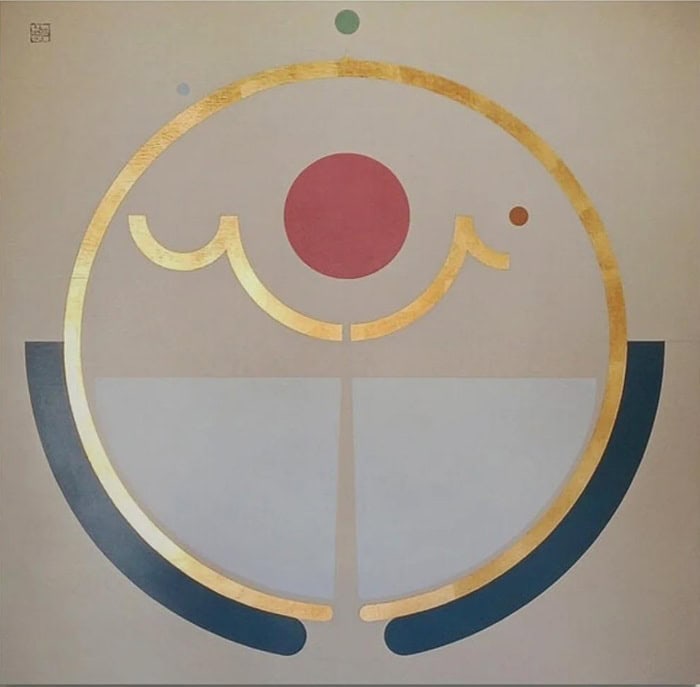
E 02 04 26
Artist
Jordi Bresolí
Exhibition
Main features
- Title: E 02 04 26
- Technical: Mixta sobre llenç
- Dimensions: 590,94x59,06 inches
- Year: 2026
- Price: 1.950 €
Description of the work
The work E 02 04 26 by the artist Jordi Bresolí.
Technique: Acrylic and gold leaf on wood.
Measures: 100 x 100 cm.
ARTWORK
Diptychon: Kirche Sankt Nikolaus und Santa Maria (Diptych of the churches of Saint Nicholas and Saint Mary)
Church of Santa Maria, Berlin
The idea of creating a diptych consisting of two churches — one cosmic (Sant Nicolas) and one telluric (Santa Maria)— can be understood as the representation of two complementary energy poles that act in balance.
The church of cosmic character symbolizes the opening towards the top: the sky, the light, the spiritual and the transcendent. It is an ascending axis, linked to the expansion of consciousness and to the connection with the universal. Instead, the Telluric Church represents the rooting: the land, matter, the ancestral (the Goddess). It is a descending axis, associated with the stability, memory and vital energy it sustains.
When both are conceived together in a diptych, they generate a symbolic dialogue between heaven and earth. At the energy level, this is interpreted as a continuous flow: the cosmic descends and inspires, while the telluric ascends and shapes. The result is a field of balance where the spiritual is incarnated and the material is raised, creating a harmonious unity between the two planes.
Geometrical study of the church
Taking into account the knowledge of the master builders, responsible for the construction of ancient temples and churches, the proportions of the plans were studied and the following elements were extracted:
- Measurement of the latitude of Berlin as a basis for the proportion and elaboration of the works
- Main traces linked to the church floor
- Rectangle and circle of fire (quadrature), related to the expansion
- Ether circle, linked to the energy of the heart
- Circle of perimeter water, in relation to the protection and projection of the gifts
Painting of the work
Considering that the geometric structure of the work is linked to telluric energies, additional elements were incorporated during the pictorial process. In the darkest part of the piece —the dark blue lower circle—, in addition to the pigments used, a small amount of gordolobo root dyeing, also called the “candela de la Verge”, was introduced in order to elevate the telluric vibration of the work.
In the central part, in the salmon circle, together with the soils and oxides necessary to create the tone, a very small dose of mandragora dyeing was added, considered a sacred and initiatory plant whose potential lies mainly in the root.
Vesica Piscis
One of the aspects of this diptych is that, on a more personal level, the idea arises that both churches work together, integrating a feminine and a masculine dimension. This intention is transferred to the works so that, when superimposing the layouts, the central and upper circles of both compositions generate a vesic fish.
The vesica piscis is an ancient symbol of the sacred geometry that represents the deep union between the masculine and the feminine, formed by the intersection of two equal circles where each one contains the other, thus evoking two complementary principles, the masculine as an active, expansive and luminous force and the feminine as a receptive, gestatory and enveloping energy, and in this shared space a central form arises that symbolizes the origin of life, a place of balance where differences do not oppose but are integrated, giving rise to a living unit in which the spiritual descends towards the material and the material rises towards the spiritual, becoming a portal of creation, transformation and harmony where duality ceases to be separation and becomes a continuous dialogue that sustains the mystery of existence.
For more information on the work E 02 04 26 by the artist Jordi Bresolí at the Espai Cavallers gallery. Galeria Espai Cavallers
Artist biography
Jordi Bresolí
The artist Jordi Bresolí was born in Lleida on December 13, 1980.
He studied artistic baccalaureate at the Màrius Torres high school. He then moved to Tàrrega to study the intermediate and advanced degree modules in artistic forging and sculpture at the Ondara school. When finishing the school it decides still to be totally with the painting.
In its first stage it focuses on a more realistic type of language, using oil painting working from glazes. As it evolves it leaves behind all the more figurative aspect and focuses on the study of new materials in a more abstract expressionist field. This whole stage of new experiments and research will finally lead him to work with a series of more natural materials. It uses pigments based on earth, clays, oxides, etc … and developing a purely geometric language.
“In a work, not only the intention and the visual aspect is important, but also the base in which the work is painted, like the materials that are used in her. Against purer the base, against purer are the materials and the way the work is displayed, the higher, more accessible and healing the vibration will be towards the spectator “
For more information on the artist Jordi Bresoli at Espai Cavallers Gallery